
Prioritizing the backlog is one of the core responsibilities of product managers. It helps the team focus on work that has the greatest potential to benefit the business and users. Prioritization is also a way to filter a long list of ideas and tasks, which usually outweigh the available time and energy.
There are many prioritization methods, each with its own pros and cons. We’ve selected four simple and popular methods that don’t require significant preparation and compiled them into this cheat sheet.
It will help you choose the optimal approach among the following methods:
- ICE
- RICE
- MoSCoW
- Value vs. Effort
ICE
Criteria
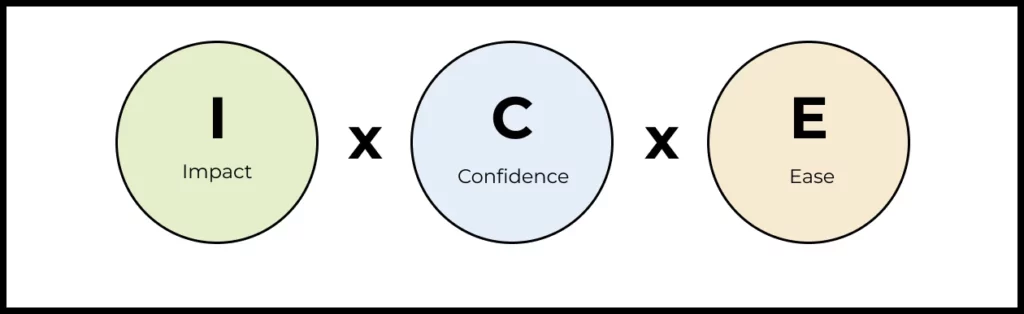
- Impact (effect on users)
- Confidence (confidence in success)
- Ease (ease of implementation)
When to use
- Quick comparison of ideas
- Early‑stage planning
Pros
- Low complexity
- Fast to apply
- Suitable for any product
Cons
- Subjective scoring
- Simplifies reality
Rules
- Rate each parameter from 1 to 10.
- Multiply the scores and prioritize the tasks with higher totals.
Formula
ICE = Impact × Confidence × Ease
Example
Should we add biometric authentication to the product? Evaluate the idea based on relevant metrics and experience:
- Impact = 8
- Confidence = 9
- Ease = 7
ICE = 8 × 9 × 7 = 504
Compare the result with the score for other ideas.
🔗 A template for Miro.
RICE
Criteria
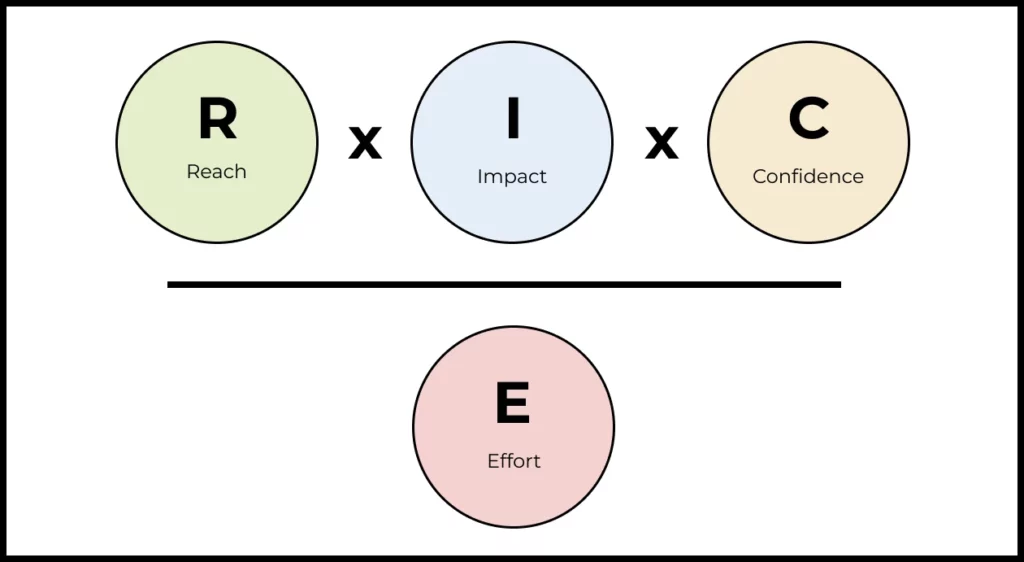
- Reach (how many people it will affect)
- Impact (effect on each user)
- Confidence (how much we trust our estimates)
- Effort (difficulty of implementation)
When to use
- Growth stage
- Release planning
Pros
- Takes reach into account
- Suitable for mature products
Cons
- Requires solid data
- Risk of bias
Rules
- Gather data on reach.
- Use a scale of 0–3 for Impact.
- Use 0–100 % for Confidence.
- Use months for Effort.
- Calculate (R*I*C)/E
Formula
RICE = (Reach × Impact × Confidence) / Effort
Example
Should we translate the product into Spanish? Evaluate the idea based on relevant metrics and experience:
- Reach = 5,000
- Impact = 2
- Confidence = 80 %
- Effort = 2.5
RICE = (5 000 × 2 × 0.8) / 2.5 = 3 200
Compare the result with the score of other ideas.
🔗 A template for Miro.
MoSCoW
Criteria
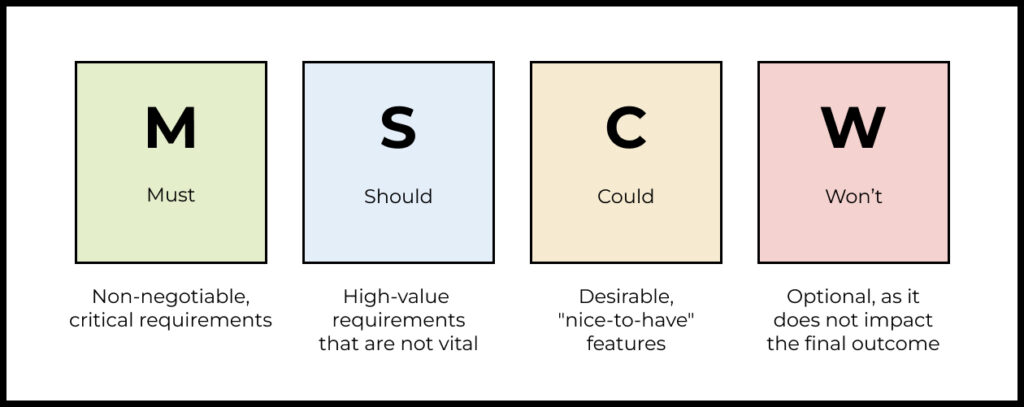
- Must have (essential feature)
- Should have (desirable feature)
- Could have (nice to have feature)
- Won’t have (not now)
When to use
- MVP
- Release planning
Pros
- Simple
- Useful in team discussions
Cons
- Vague categories
- Not well suited to a large volume of tasks
Rules
- Discuss the categories with the team.
- Limit the number of Must have features (those without which the product is not viable) to a few (three to five) tasks so you don’t end up labeling everything as Must have.
Example
You have 15 ideas and tasks. You discuss them with the team, and each participant votes on the priority level based on their expertise.
It is decided that:
- 3 ideas 🟢 = Must have
- 5 ideas 🔵 = Should have
- 3 ideas 🟡 = Could have
- 4 ideas 🔴 = Won’t have
🔗 A template for Miro.
Value vs. Effort
Criteria
- Value
- Effort
When to use
- Quick planning
- Limited resources
Pros
- Visual
- Simple
Con
- Rough estimates
Rules
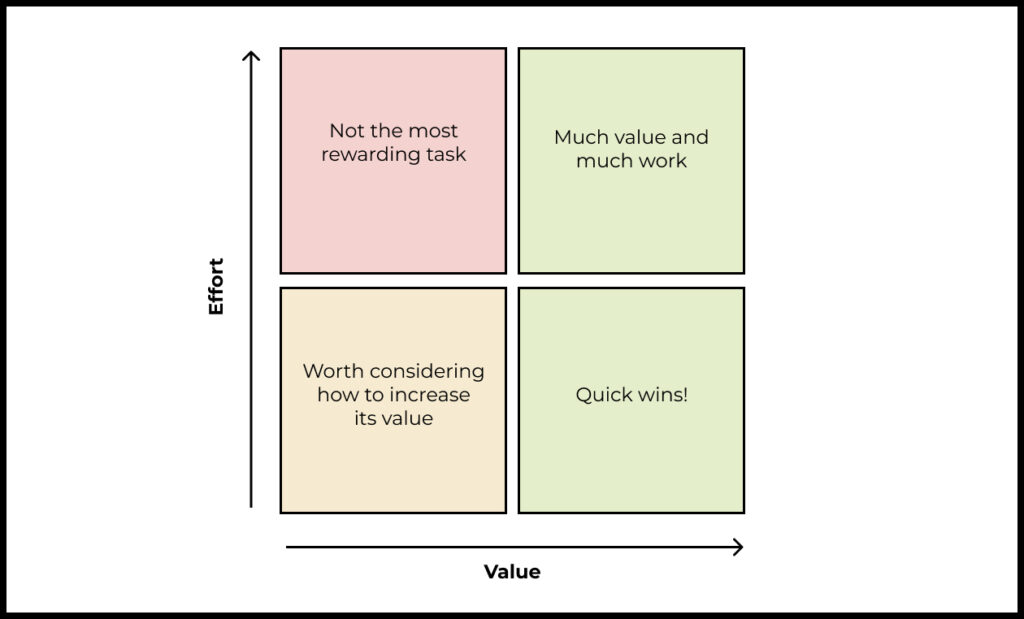
- Draw a 2 × 2 matrix.
- For each idea or task, rate its Value (using metrics) and its Effort (using timeframes) on your chosen scale (1–5 or 1–10, whichever is more convenient).
You will end up with four quadrants.
🔗 A template for Miro.